
How Many Calories Should You Eat a Day?
How many calories should you eat a day? Get your number from the Mifflin-St Jeor formula, adjust it for your goal, then let two weeks of data confirm it.
Meghan Salamon, a registered dietitian at the Massachusetts General Hospital Weight Center, writing in Harvard Health on June 23, 2026, gives 1,200 to 1,500 calories a day for the average woman without severe obesity and 1,500 to 1,800 calories a day for the average man as the usual range for losing weight, and recommends starting from a deficit of 500 calories a day. That is the short answer to how many calories should you eat a day. The useful answer comes from three things in order: a formula, a goal, and two weeks of your own data.
This guide is written for healthy adults. It is general information and not medical advice, and it does not replace a doctor or a registered dietitian.
How many calories should you eat a day to lose weight?
Take your maintenance level and subtract 500 calories a day. Maintenance is what your body burns in a day: your resting energy expenditure, which is what you would burn lying still, plus everything you do on top of it. Together those two pieces are your total daily energy expenditure, and they are the only reason the answer is personal rather than universal.
The Centers for Disease Control and Prevention, in “Steps for Losing Weight,” states that people who lose weight at a gradual, steady pace of about 1 to 2 pounds a week are more likely to keep it off than people who lose faster. A 500-calorie daily deficit sits inside that pace for most adults.
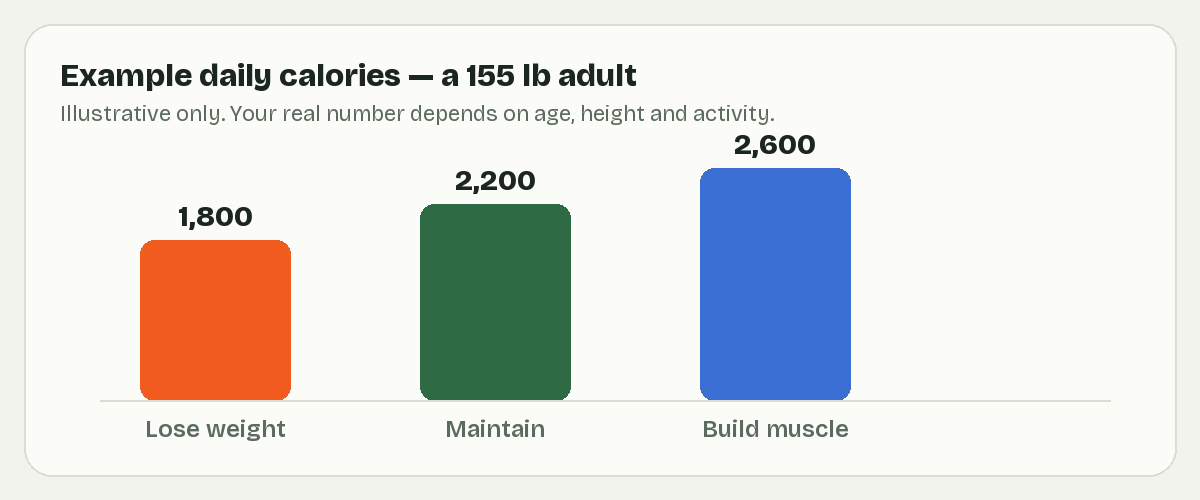
| Goal | Starting adjustment | What to expect |
|---|---|---|
| Lose weight | 500 calories a day below maintenance | 1 to 2 pounds a week (CDC) |
| Maintain | At maintenance | Weight steady apart from daily water swings |
| Gain muscle | A modest surplus, paired with resistance training | Slow gain, part muscle and part fat |
A worked example: if your estimated maintenance is 2,200 calories, your weight-loss target is about 1,700 calories a day. If it is 2,600, your target is about 2,100.
Which formula does a calorie app use to estimate your needs?
Kalo.Quest uses the Mifflin-St Jeor equation, and says so in the app: “Estimate based on your metabolism (Mifflin-St Jeor), body type and activity.” The equation was published by Mifflin, St Jeor and colleagues in the American Journal of Clinical Nutrition in February 1990 under the title “A new predictive equation for resting energy expenditure in healthy individuals.” It takes four inputs:
- Weight. A larger body costs more energy to maintain.
- Height. Taller bodies have more tissue to keep warm.
- Age. The equation subtracts 5 calories of resting expenditure for every year.
- Sex. A fixed offset separates the two versions of the formula.
The result is resting energy expenditure. An activity multiplier is then applied on top, from sedentary through to very active, to produce maintenance. The National Institute of Diabetes and Digestive and Kidney Diseases publishes a public alternative, the Body Weight Planner, which models how intake and activity change body weight over time.
Treat whatever number comes out as a hypothesis. Two people with identical inputs can differ by a few hundred calories a day because of muscle mass, genetics and how much they move without noticing.
How much should you subtract from maintenance to lose weight?
Five hundred calories a day is the figure Salamon names as a starting point in the Harvard Health guide. Expressed as a share, that is roughly 15% to 25% below maintenance for most adults, which is the same instruction stated a second way rather than a competing rule.
Bigger is not better. A deeper cut removes weight faster on paper and brings more hunger, more fatigue and a higher chance of stopping. If you want the reasoning behind the size of the gap, what a calorie deficit is covers it in full.
What is the lowest daily calorie intake that is considered safe?
For general weight loss, the floor is the bottom of the ranges Salamon cites in Harvard Health: about 1,200 calories a day for women and about 1,500 for men. The same guide lists persistent fatigue, irritability and an unusual preoccupation with food as signs that a deficit has become too aggressive.
Going below those figures is not a self-service decision. Very low calorie intakes are used clinically, under supervision, with monitoring that a phone app cannot provide. These ranges also do not apply to pregnancy, breastfeeding, anyone under 18, anyone with a history of disordered eating, or anyone following an intake prescribed by a clinician. In all of those cases the number comes from a healthcare professional, not from a formula.
Protein is the one nutrient worth defending as calories come down, because it is what protects muscle during weight loss. How much protein per day gives the grams.
How do you check whether your calorie target is actually right for you?
Hold the target for two to three weeks and read the trend, not the morning number. The protocol:
- Weigh under the same conditions. Same time of day, same clothing, same scale.
- Use the weekly average, not any single reading. Day-to-day swings of a pound or two come from water, sodium and food still in transit.
- Log every day, including the days that go badly. A log with holes in it cannot answer the question.
- Compare after 14 to 21 days. Losing faster than 2 pounds a week, or feeling drained, means adding calories back. Nothing moving at all means either the target is too high or the logging is missing calories.
That last possibility is the common one. In the New England Journal of Medicine of December 31, 1992, Lichtman and colleagues studied subjects who reported being unable to lose weight despite eating under 1,200 calories a day. The group underreported its actual intake by 47% on average and overreported its physical activity by 51%. Their metabolism was normal. Their record-keeping was not.
The calculator opens the conversation; your data closes it. That only works if the logging happens, which is why a method that takes seconds matters more than a method that is theoretically exact. Counting calories from a photo explains how that works and how accurate it is.
Why do calorie targets stop working after a few weeks?
Because the target was set for a body that no longer exists, and because logging drifts. Both effects are small each week and both compound.
- Your maintenance falls as you lose weight. A smaller body burns less, so a number that once created a deficit eventually only matches maintenance.
- Activity gets overestimated. Most people who train a few times a week are lightly active, not very active. Choosing the wrong multiplier inflates the target from day one.
- Drinks and extras go unrecorded. Juice, soda, alcohol, the oil in the pan, the splash of cream. They carry calories without filling you up, and they are the most common reason a deficit closes quietly.
- The number gets chased instead of used. Needs shift with sleep, stress and activity. Recheck every few weeks rather than expecting one figure to hold for a year.
Recalculating every 10 to 15 pounds of change, and rereading the weekly average, is enough to keep the target honest.
Kalo.Quest is an app on Google Play and the App Store. It builds a daily calorie goal from your profile and your weight goal, with an estimated date for reaching it, and it reads calories and macros from a photo of the plate. It is free and ad supported, with an ad after each analysis and a limit of 30 photo analyses a day; an optional rewarded video adds one more. There is no account to create. What it is not is a medical device: for a prescribed intake, or for any condition that changes what you should eat, talk to a healthcare professional.
FAQ
Is a kcal the same thing as a calorie?
On a nutrition label, yes. One food Calorie equals one kilocalorie, which is 1,000 of the small calories used in physics. American labels write “Calories” and most scientific sources write “kcal” for the same quantity, which is why USDA FoodData Central lists energy in kcal. A 500-kcal meal and a 500-Calorie meal are identical.
Do your daily calorie needs change as you get older?
Yes, and the Mifflin-St Jeor equation puts a number on it: resting energy expenditure falls by about 5 calories for every year of age, holding weight and height constant. Over twenty years that is roughly 100 calories a day. Changes in muscle mass and daily movement usually matter more than age alone, but the drift is real and worth recalculating for.
Should you eat back the calories you burn from exercise?
Usually not in full. Fitness trackers and gym machines tend to read high, and Lichtman and colleagues found people overestimating their physical activity by 51% on average. A common approach is to pick an activity level that already includes your normal training, then leave the target alone. If you are genuinely hungry after long sessions, add food back gradually and watch the weekly trend.
This article is general information, not medical advice. For personal guidance, talk to a healthcare professional.