How Much Protein Per Day Do You Need?
How much protein per day do you need? Start at the 0.8 g/kg RDA, then see the higher ranges for weight loss and training, with grams per real portion.
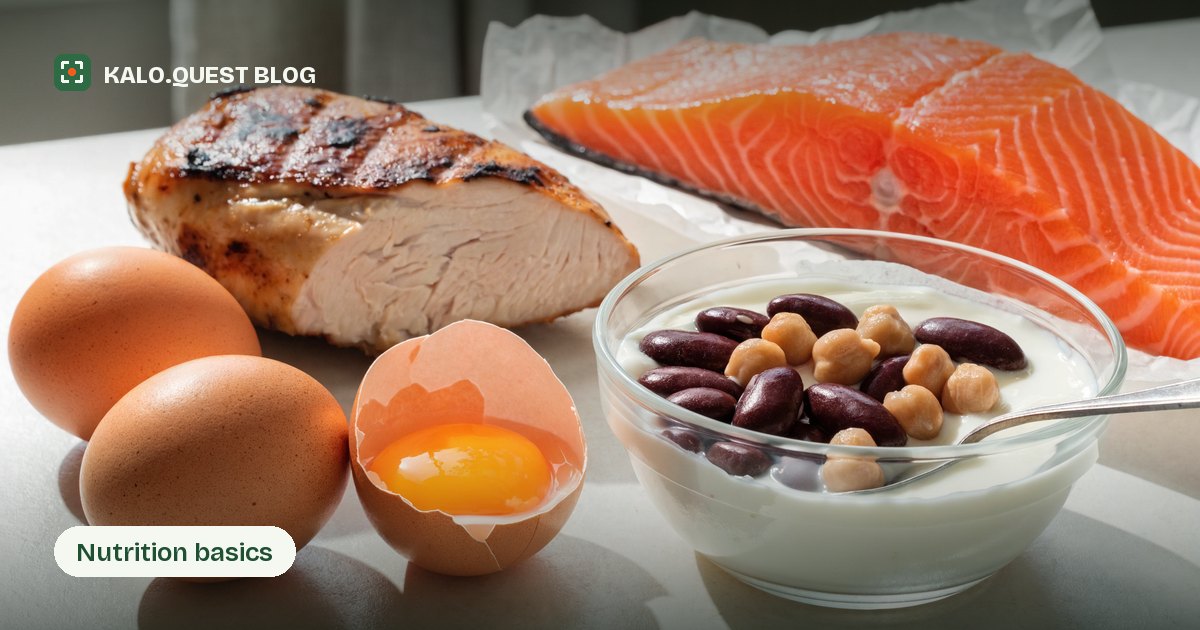
The Recommended Dietary Allowance for protein is 0.8 grams per kilogram of body weight per day, which the Harvard T.H. Chan School of Public Health translates as just over 7 grams for every 20 pounds: about 50 grams a day for a 140-pound person and about 70 grams for a 200-pound person. That is the floor, and it is the honest starting answer to how much protein per day you need. Losing weight or training regularly pushes the target higher, and this guide gives both numbers in grams and in food.
This is general information for healthy adults, not medical advice, and it does not replace a doctor or a registered dietitian.
How much protein per day do you actually need?
The RDA of 0.8 g per kilogram is set by the National Academy of Medicine and cited on The Nutrition Source at Harvard T.H. Chan School of Public Health. It is a minimum designed to prevent deficiency in most healthy adults, not a performance target.
| Body weight | RDA at 0.8 g/kg | Higher range at 1.2 to 1.6 g/kg |
|---|---|---|
| 120 lb (54 kg) | 44 g/day | 65 to 87 g/day |
| 140 lb (64 kg) | 51 g/day | 76 to 102 g/day |
| 180 lb (82 kg) | 65 g/day | 98 to 131 g/day |
| 200 lb (91 kg) | 73 g/day | 109 to 145 g/day |
The middle column is the arithmetic at 0.8 g/kg, which Harvard rounds to about 50 g and 70 g for the two examples above. Think of it as the amount that keeps you healthy, and of the third column as the amount that supports a body composition goal. Both are ranges to land near, not lines to hit.
How much protein should you eat to lose weight or build muscle?
Between 1.2 and 1.6 grams per kilogram of body weight per day, with at least 25 to 30 grams at each meal. Those figures come from Leidy and colleagues in the American Journal of Clinical Nutrition of June 2015, a review of the evidence on protein in weight loss and maintenance.
Three findings from that review are worth carrying with you:
- Fat loss and lean mass. Meta-analyses of controlled feeding studies showed greater weight loss, greater fat mass loss, and better preservation of lean mass on higher-protein energy-restricted diets than on lower-protein ones.
- Fullness. Acute feeding trials confirmed a modest satiety effect, with greater perceived fullness and higher satiety hormones after higher-protein meals. The same review notes this did not reliably reduce intake at the next meal, so the effect is real but not magical.
- Adherence decides it. Longer-term studies produced conflicting results, and the review attributes the discrepancy mainly to compliance: benefits appeared in the people who actually stuck to the higher-protein pattern.
That combination is exactly what you want while eating in a calorie deficit, which is where the protein question usually comes from in the first place.
What does a day’s worth of protein look like on a plate?
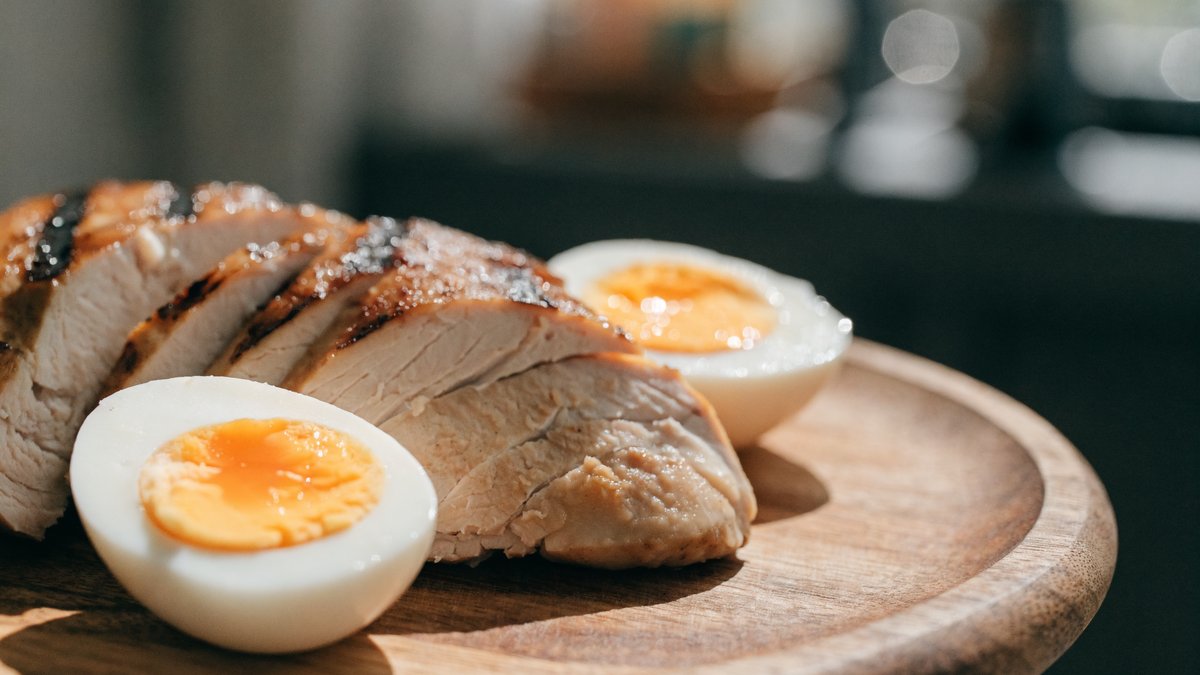
Grams become useful when they are attached to food. Every value below is from USDA FoodData Central, for the portion stated.
| Food and portion | Protein | Calories |
|---|---|---|
| Chicken breast, roasted, skinless, 4 oz (113 g) | 35 g | 186 |
| Cottage cheese, lowfat 1%, 1 cup (226 g) | 28 g | 163 |
| Salmon, Atlantic, farmed, cooked, 3 oz (85 g) | 19 g | 175 |
| Lentils, cooked, 1 cup (198 g) | 18 g | 230 |
| Greek yogurt, plain, nonfat, 6 oz (170 g) | 17 g | 100 |
| Tofu, firm, 1/2 cup (126 g) | 22 g | 181 |
| Black beans, cooked, 1 cup (172 g) | 15 g | 227 |
| Egg, hard-boiled, 1 large (50 g) | 6 g | 78 |
Read the table twice, once for the protein column and once for the calories. Chicken breast and Greek yogurt deliver protein cheaply in energy terms; lentils and black beans deliver it alongside a large carbohydrate load, which is fine but has to fit the day. A 160-pound person aiming at 1.4 g/kg needs about 102 grams a day: a chicken breast portion, a cup of cottage cheese, a salmon portion and a container of Greek yogurt come to 99 grams between them.
Can you hit a protein target on a plant-based diet?
Yes, with slightly more planning, because plant portions usually carry fewer grams per serving. The heavy hitters, again from USDA FoodData Central: tempeh at 34 g of protein per cup (166 g), edamame at 18 g per cup of prepared frozen beans (155 g), firm tofu at 22 g per half cup, lentils at 18 g per cooked cup, and black beans at 15 g per cooked cup.
Building a plant-based day around three of those, plus whole grains, nuts and seeds in the background, lands most people in the 1.2 g/kg region without difficulty. The practical difference is that the calories arrive with the protein rather than beside it, so the day needs a little more shaping. The same principle drives the choices in what to eat while losing weight.
Does protein timing matter, or only the daily total?
The daily total does nearly all the work. Once you know how much protein per day you are aiming at, the schedule is a second-order decision.
The one structural point supported by Leidy and colleagues is per-meal quantity: about 25 to 30 grams per meal, which usually means fixing breakfast, the meal where most people fall shortest. The old rule that protein must be consumed within minutes of training has been massively oversold; over a day of adequate intake, the exact minute barely registers. Spreading protein across three or four eating occasions is easier to achieve than one enormous dinner, and that is the real argument for it.
Can you eat too much protein?
There is an upper bound. The National Academy of Medicine sets an acceptable range of 10% to 35% of daily calories from protein, as cited by The Nutrition Source. On a 2,000-calorie day, 35% is 700 calories, or about 175 grams of protein, which is well above the ranges above.
The Nutrition Source also notes that people diagnosed with certain conditions, kidney and liver disease among them, need to monitor protein intake according to their physician’s guidelines. That is the boundary of this article: it describes general targets for healthy adults, and it does not cover medical nutrition therapy, kidney disease, or the requirements of pregnancy, breastfeeding or growth in children.
To find out where you actually land, you have to count for a while. Protein grams are the hardest macronutrient to eyeball, which is why tracking macros is worth a couple of weeks even if you never do it again. Kalo.Quest is an app on Google Play and the App Store that returns calories, protein, carbohydrates and fat from one photo of the plate, straight into the day’s journal. It is free and ad supported, with an ad after each analysis and a limit of 30 photo analyses a day; an optional rewarded video adds one more, and there is no account to create.
FAQ
Does your protein target change on rest days?
Not meaningfully. The ranges from Leidy and colleagues are daily averages built on body weight, not on training volume, and muscle repair continues for days after a session. Keeping intake steady across the week is simpler to execute and easier to hit than adjusting up and down, and simplicity is what determines whether the target is actually reached.
Do you need a protein shake to reach your daily total?
No. Nothing in the RDA or in the higher ranges requires a supplement, and the USDA portions above show that whole foods cover the numbers comfortably. A powder is a convenience for a rushed morning, not a requirement, and it is priced as food rather than as medicine. If whole foods already get you to your range, adding a shake adds calories and nothing else.
How do you count the protein in a mixed dish like a curry?
Estimate the protein source separately from everything else. Judge the meat, fish, tofu or legumes by portion, apply the grams from the table above, and treat the sauce and rice as calories rather than as protein. A photo estimate does this decomposition for you and returns protein alongside calories, which is faster than searching a database for a dish nobody has entered.
This article is general information, not medical advice. For personal guidance, talk to a healthcare professional.