How to Count Calories When Eating Out
How to count calories when eating out: which US chains must post calories, what a restaurant meal really costs you, and how to estimate the rest.
The short version of how to count calories when eating out: read the posted figure if the restaurant is part of a chain with 20 or more locations, because federal law requires it; otherwise assume a full restaurant meal costs around 1,200 calories and estimate from there. Independent restaurants and large chains serve almost identical amounts, which is the finding most people get wrong.
This article is general information for healthy adults, not medical advice, and it does not replace a doctor or a registered dietitian.
How do you count calories when eating out?
Work from the strongest source available, in this order: a posted calorie count, then a published menu you can check before you arrive, then a comparison with a meal you already track at home, then a photograph of the plate. Log whichever you get and move on.
Precision is not the objective. The CDC, in “Steps for Losing Weight,” describes losing about 1 to 2 pounds a week as the pace most associated with keeping weight off, and that pace is judged on a weekly trend. A restaurant estimate that is honest and roughly right keeps the trend readable. A meal you refuse to record because you cannot be exact does not.
Which US restaurants are required to publish calorie counts?
Chains with 20 or more locations. The FDA’s menu labeling requirements apply to restaurants and similar retail food establishments that are part of a chain of 20 or more locations, doing business under the same name and offering for sale substantially the same menu items. The compliance date was May 7, 2018.
What that gets you, in practice:
- Calories on the menu and menu boards for standard items, and for self-service foods and foods on display, listed close to the item.
- On request, written nutrition information: total calories, total fat, saturated fat, trans fat, cholesterol, sodium, total carbohydrates, sugars, fiber and protein.
- A posted statement that 2,000 calories a day is used for general nutrition advice, with the note that individual needs vary.
The practical move is to look the menu up online before you leave the house. The same numbers are on the chain’s website, and reading them before you are hungry is a different exercise from reading them after the bread arrives.
How many calories is a typical restaurant meal?
About 1,200, and nearly 1,500 for the most popular cuisines. Urban and colleagues measured the energy content of frequently ordered meals by bomb calorimetry in restaurants in San Francisco, Boston and Little Rock between 2011 and 2014, publishing in the Journal of the Academy of Nutrition and Dietetics in April 2016.
| Measurement | Result |
|---|---|
| Mean energy, independent restaurants | 1,205 kcal per meal (SD 465) |
| American, Italian and Chinese cuisines | 1,495 kcal per meal |
| Meals above typical requirements for one eating occasion | 92% |
| Difference versus equivalent large-chain meals | +5.1%, not significant (P = 0.41) |
That last row is the one worth keeping. The independent bistro is not the safe choice and the chain is not the villain; the portions are the same size in both. If a full meal typically lands near 1,200 calories, a single restaurant dinner can absorb most of a day’s target on its own, which is a scheduling problem rather than a moral one.
Where do the hidden calories in restaurant food come from?
Three places, none of them visible on the plate.
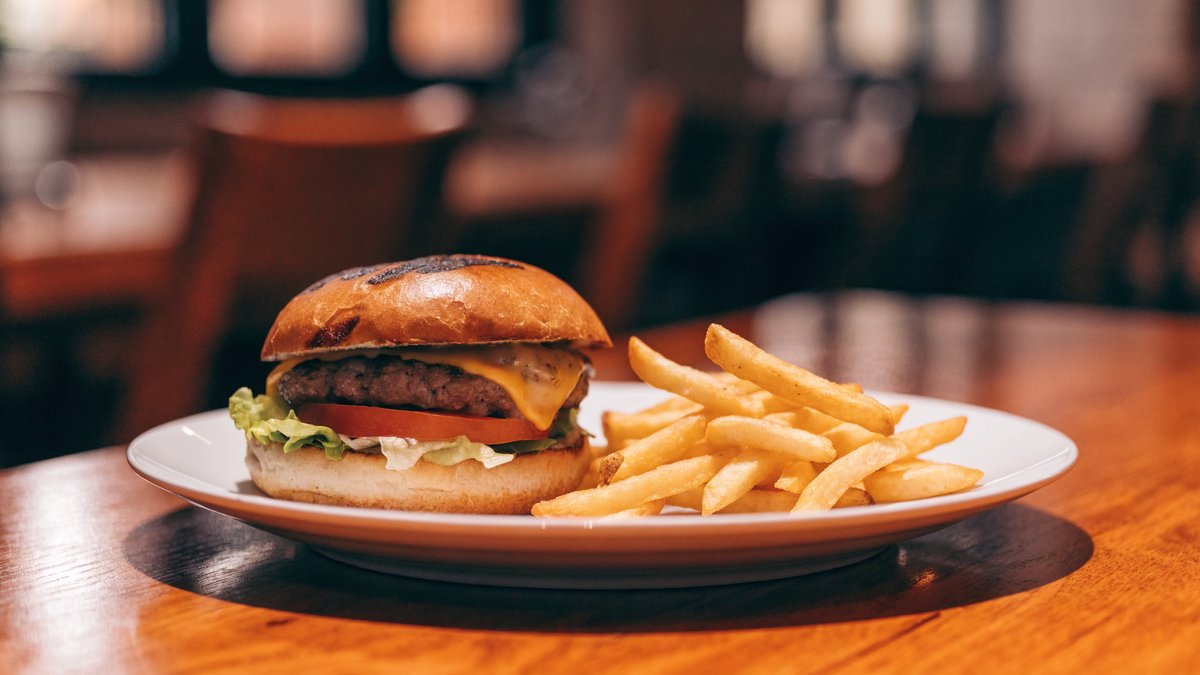
- Cooking fat. Restaurant kitchens use oil and butter far more freely than home cooks, and a spoonful of oil carries more calories than most people expect for its volume. The exact figure, from USDA FoodData Central, is in our guide to reading a plate from a photo.
- Sauces, dressings and glazes. Calorie-dense and hard to gauge. Ordering them on the side is the one request that reliably improves both the estimate and the total.
- Drinks and sides. Soda, juice, alcohol and the bread basket are the most frequently forgotten items of the meal, and they routinely add more than the main course.
How do you estimate a plate you cannot break into parts?
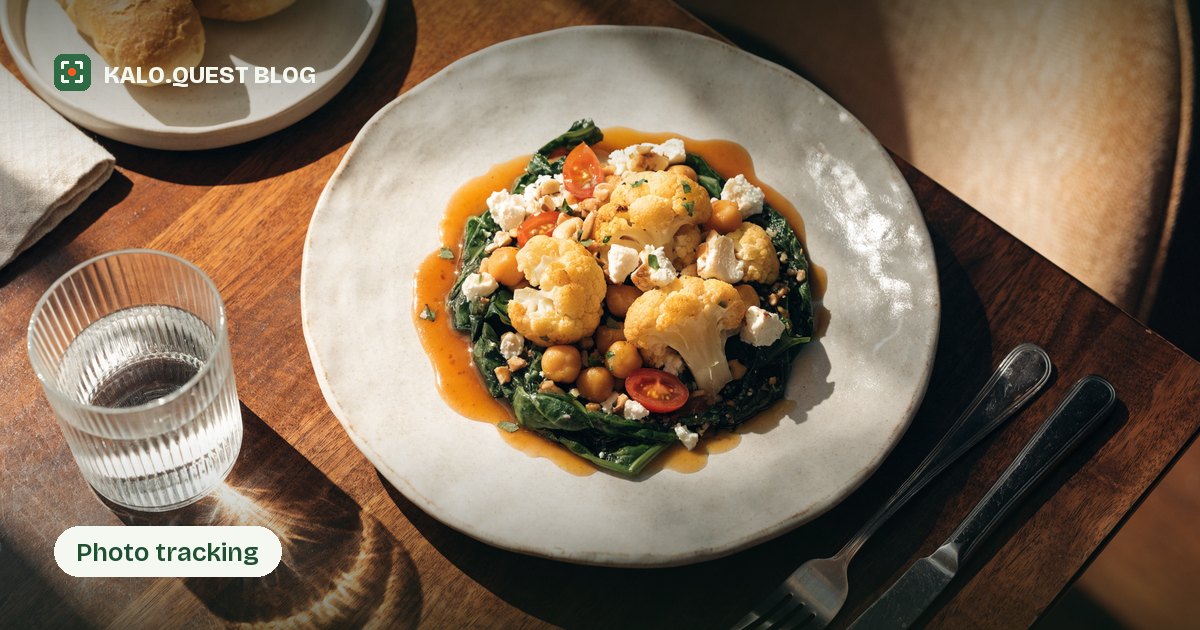
Photograph it. A mixed curry, a loaded bowl, a stew with an unknown amount of cream: these defeat item-by-item estimation, and the reasonable answer is to let a portion-weight estimate handle the decomposition instead of guessing each component.
Where the plate is simple, comparison works better than any rule of thumb. Judge the protein against a portion you weigh at home, and the starch against a serving you already log. The hand method, a palm of protein and a fist of carbohydrate, is a fast approximation and nothing more.
| Tactic | Why it helps |
|---|---|
| Check the posted menu online first | Chains of 20 or more locations must publish calories (FDA) |
| Compare to a meal you already track | Turns an unknown plate into a known one |
| Box half immediately | Halves the estimate and the error at the same time |
| Photograph the plate | Handles mixed dishes that cannot be itemized |
The whole of how to count calories when eating out compresses into five moves, in the order you actually need them:
- Decide before you are hungry. Read the menu on the way, not at the table.
- Pick a protein-forward main. Grilled or roasted dishes with a visible protein and vegetables are easier to estimate than anything blended or sauced.
- Control the add-ons. Sauces on the side, water as the default drink, and one deliberate decision about the bread and the fries.
- Estimate or photograph. Compare against known meals, and when the plate resists that, take the picture.
- Log it and let it go. An honest ballpark you record beats a perfect number you never write down.
How close does a restaurant estimate have to be?
Close enough that the weekly average is not misleading. If you eat out twice a week and your estimates are off by 200 calories each time, that is 400 calories across a week, which is smaller than the swing produced by one forgotten drink.
This is where the tolerance ends. A restaurant estimate is not a measurement, and it is not adequate where a clinical prescription depends on exact figures: carbohydrate counting to the unit for insulin dosing, a renal diet, or any case where an allergen has to be excluded with certainty. Those numbers come from your care team, and no photograph substitutes for asking the kitchen.
How often restaurant meals matter depends entirely on how often you eat them. Someone who eats out twice a month and someone who eats out daily are in different situations, and only the second one needs restaurant estimates to be good. If most of your meals happen at home, the accuracy that decides your results is the accuracy of your ordinary logging, which is a question of keeping the deficit honest rather than of restaurant arithmetic. If you want protein, carbohydrate and fat from those meals as well as calories, tracking macros covers the extra step.
Kalo.Quest is an app on Google Play and the App Store that estimates the portion weights on a plate and returns calories and macros into the day’s journal, which is the part restaurants make hard. It is free and ad supported, with an ad after each analysis and a limit of 30 photo analyses a day; an optional rewarded video adds one more, and there is no account to create.
FAQ
Should you round a restaurant estimate up or down?
Up. Urban and colleagues found that 92% of the restaurant meals they measured exceeded typical energy requirements for a single eating occasion, and that independent restaurants matched the large chains for portion size. Systematic underestimation is the failure mode that quietly closes a deficit, so when two plausible figures present themselves, record the larger one.
Do the calories printed on a chain menu match what you are served?
Treat them as the best available figure rather than an exact one. The FDA requires covered chains to disclose calories for standard menu items, but the plate in front of you is prepared by a person, and portioning varies between locations and shifts. The printed number is far more reliable than a guess and less reliable than a scale.
How do you count calories for a plate you share with someone?
Estimate the whole dish first, then record your share of it. Deciding “about a third of the platter” before you start eating is much more accurate than reconstructing it afterwards. If you photograph the plate, take the picture before anyone serves themselves and apply the fraction to the result.
This article is general information, not medical advice. For personal guidance, talk to a healthcare professional.